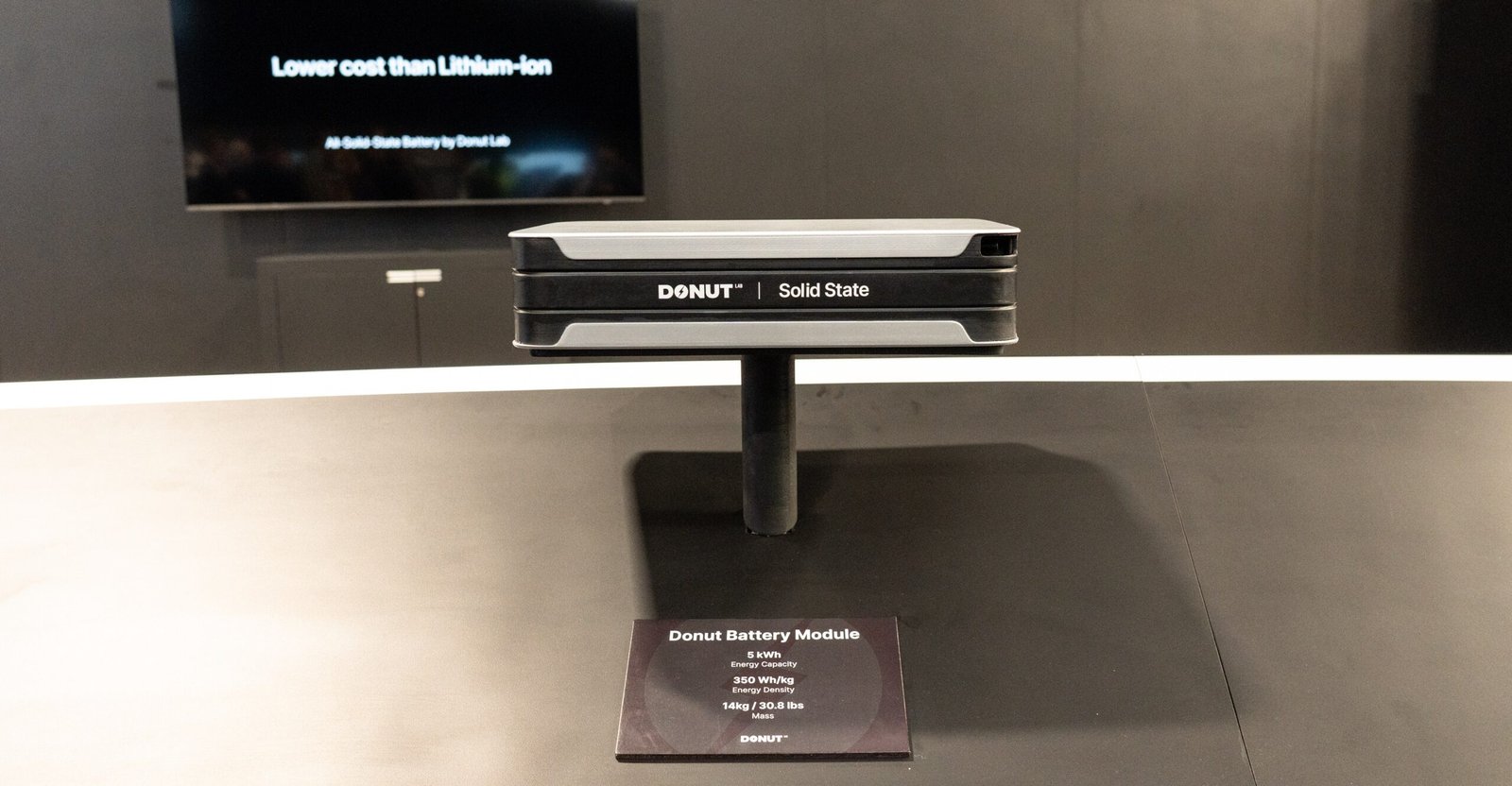
Finnish startup Donut Lab has officially refuted allegations that its solid-state battery technology is merely a rebranded supercapacitor, following a third round of independent verification by the VTT Technical Research Centre of Finland released this week.
Putting the “Supercapacitor” Theory to Rest
Ever since Donut Lab unveiled its solid-state battery earlier this year, skeptics have questioned whether the technology was actually a supercapacitor. While supercapacitors share the ability to charge and discharge rapidly, they differ fundamentally from batteries in energy density and long-term storage capabilities. To address these doubts, the startup commissioned VTT to perform rigorous charge retention testing.
“Many have said that the specifications of Donut battery can only be achieved with supercapacitor,” said CEO Marko Lehtimäki in a recent video update. “Well, today we are proving that is not the case.”
The 10-Day Stability Test
To determine the true nature of the cell, VTT engineers connected the battery to a tester and monitored its voltage every 10 seconds over a 10-day idle period. The results were conclusive: the cell maintained high stability, retaining 97.7 percent of its energy throughout the duration of the test.
[Media: https://www.youtube.com/watch?v=77kF5GEnQM8]
While the team observed a minor voltage drop from 3861mV to 3722mV during the first hour—attributed to initial chemical stabilization—the cell showed no signs of the rapid, linear self-discharge typical of supercapacitors. According to VTT, this performance confirms “normal battery-type charge retention,” effectively distancing the device from the rapid energy loss seen in capacitor-based storage.
Why the Stakes Are High
Donut Lab’s push for transparency is driven by the ambitious nature of its claims, which many industry experts have found difficult to believe. Solid-state batteries are widely considered the “holy grail” of energy storage, promising to eliminate the fire risks and thermal runaway issues associated with current lithium-ion technology while significantly boosting electric vehicle range.
The startup’s performance metrics are particularly bold: Donut Lab claims its battery achieves 400 watt-hours per kilogram—far exceeding the 200 to 300 Wh/kg standard of modern lithium-ion batteries. Furthermore, the company asserts its cells can charge in under 10 minutes and endure up to 100,000 cycles, a massive leap over the 1,500 to 3,000-cycle lifespan of current market alternatives.
The Road Ahead
Despite these successful retention tests, significant questions remain. The industry is still waiting for independent verification regarding the battery’s specific chemistry. Furthermore, the startup has yet to explain how it manages the “dendrite issue,” a common hurdle for solid-state technology where microscopic metallic structures grow within the electrolyte and cause electrical shorts. Donut Lab has hinted that these technical details may be addressed in future installments of its “I Donut Believe” testing series.