
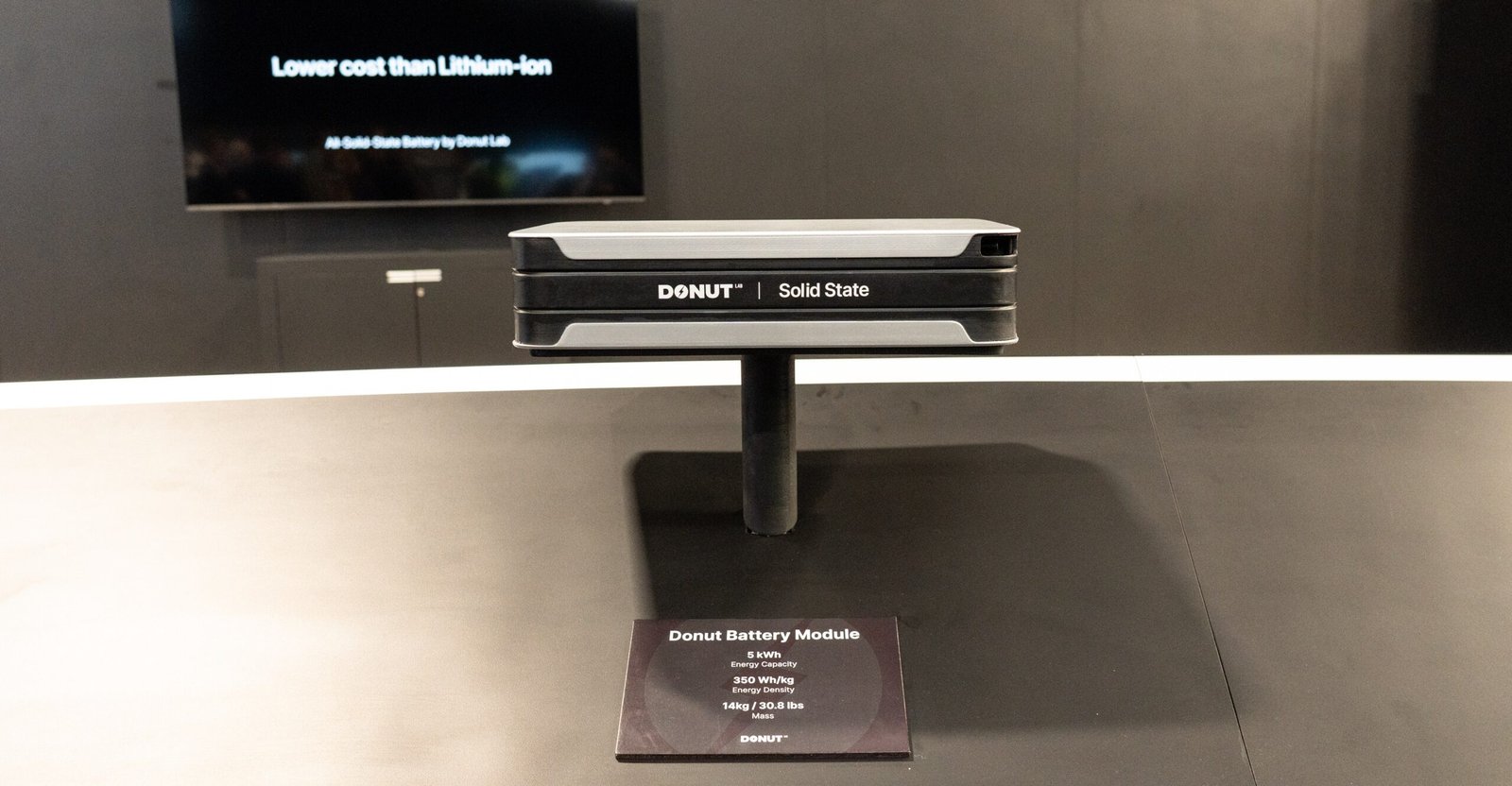
Finnish startup Donut Lab has successfully demonstrated that its solid-state battery technology thrives under extreme thermal stress, maintaining functionality—and even increasing capacity—at temperatures as high as 100°C (212°F). The independent verification, conducted by the VTT Technical Research Centre of Finland, follows previous tests focused on the battery’s rapid-charging capabilities.
Performance Under Extreme Thermal Pressure
In a rigorous evaluation, VTT researchers subjected a 3.6V/26 Amp-hour solid-state cell to three distinct thermal environments: a 20°C baseline, 80°C “high heat,” and 100°C “extreme heat.” To simulate real-world stress, the battery was placed on a heatsink inside a temperature-controlled chamber, with physical pressure applied via a steel plate.
The results defied standard expectations for lithium-ion technology. At the 20°C baseline, the cell delivered 24.9Ah. Surprisingly, performance improved as temperatures climbed: the battery delivered 27.5Ah at 80°C (110.5% of its room-temperature capacity) and 27.6Ah at 100°C (107.1%). While the battery maintained its ability to recharge after the test, researchers noted that the cell’s vacuum seal failed under the 100°C conditions.
The Physics of Solid-State Efficiency
VTT’s findings highlight a fundamental advantage of Donut Lab’s design: increased efficiency at higher temperatures. In traditional “wet” lithium-ion batteries, liquid electrolytes are prone to vaporization and thermal runaway—a dangerous process where the battery overheats and catches fire. Furthermore, liquid electrolytes degrade at high temperatures, leading to swelling and reduced service life.
Donut Lab’s solid-state architecture replaces these flammable liquids with dry conductive materials. The study suggests that heat reduces the internal resistance of the solid electrolyte, facilitating easier ion movement. This discovery suggests a future for electric vehicles (EVs) that offer longer range, faster charging, and significantly improved reliability in harsh climates.
Addressing the “Holy Grail” Challenges
Solid-state technology has long been considered the “holy grail” of energy storage due to its potential to eliminate the flammability risks associated with standard EV batteries. However, despite these promising thermal results, industry experts remain cautious.
The VTT report leaves critical questions unanswered, specifically regarding the exact chemical composition of the pack. Additionally, the test did not address the “dendrite issue”—the formation of microscopic, needle-like structures that can grow between the anode and cathode, eventually causing internal electrical shorts. Donut Lab has indicated that these challenges may be addressed in future independent evaluations as part of its ongoing “I Donut Believe” testing series.