
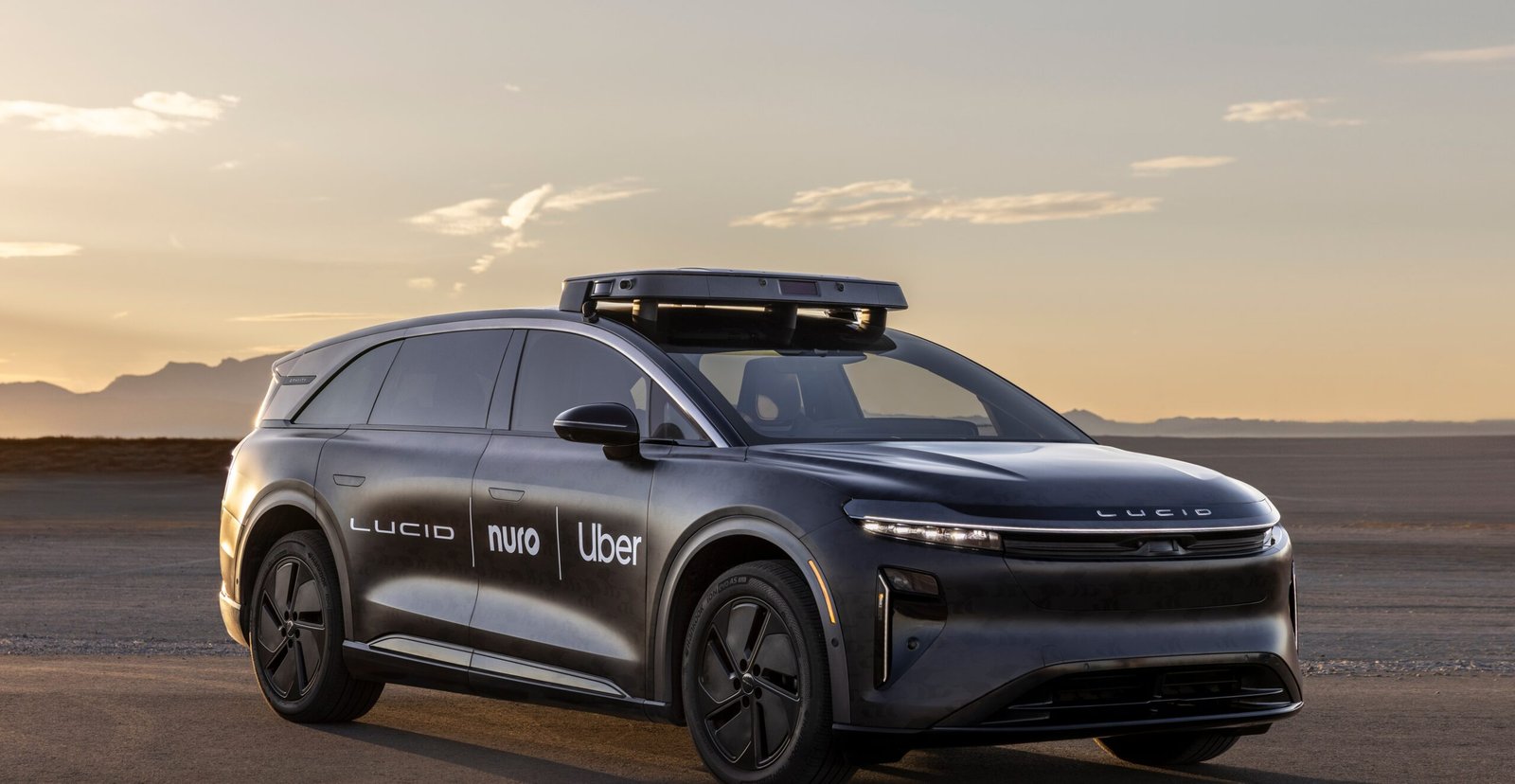
Lucid Motors has officially delivered its first Gravity SUV to Nuro, marking the initial step in a massive partnership with Uber to deploy 20,000 autonomous vehicles across the United States over the next six years.
From Factory Floor to Autonomous Prototype
The vehicle, manufactured at Lucid’s Casa Grande, Arizona facility, was transported to the automaker’s headquarters in Newark, California. There, the Nuro team performed the initial integration of sensors and autonomous hardware. Unlike this bespoke engineering prototype, future vehicles will undergo retrofitting directly on Lucid’s assembly line to streamline large-scale production.
The prototype is currently stationed at Nuro’s Santa Clara facility. Engineers are now focused on integrating the proprietary Nuro Driver software, initiating a rigorous phase of testing and validation. The companies remain on track to launch their first road-ready robotaxi on the Uber network within the next year.
The Road Ahead: Scaling the Robotaxi Vision
While the delivery of this first unit represents a key milestone, the path to deploying a fleet of 20,000 vehicles remains complex. Executives from Nuro have suggested the deal could eventually scale well beyond the initial 20,000-vehicle commitment, though the industry’s history serves as a cautionary tale.
Industry Realities vs. Ambitious Goals
The scale of this agreement mirrors the optimistic, yet often unfulfilled, projections made by early autonomous vehicle developers. Previous industry forecasts regarding the rapid deployment of tens of thousands of self-driving cars have frequently missed the mark, with many firms currently struggling to maintain even small-scale operations.
For context, Waymo currently operates fewer than 2,000 vehicles within limited commercial markets. Meanwhile, Tesla’s “robotaxi” efforts remain in a nascent stage, primarily testing with safety monitors in restricted areas like Austin, Texas. As the rest of the sector continues to navigate beta-testing hurdles and technical setbacks—particularly in the autonomous trucking space—the Lucid-Nuro-Uber alliance faces the challenge of translating high-level ambitions into a functional, public-facing reality.